

















In two minutes
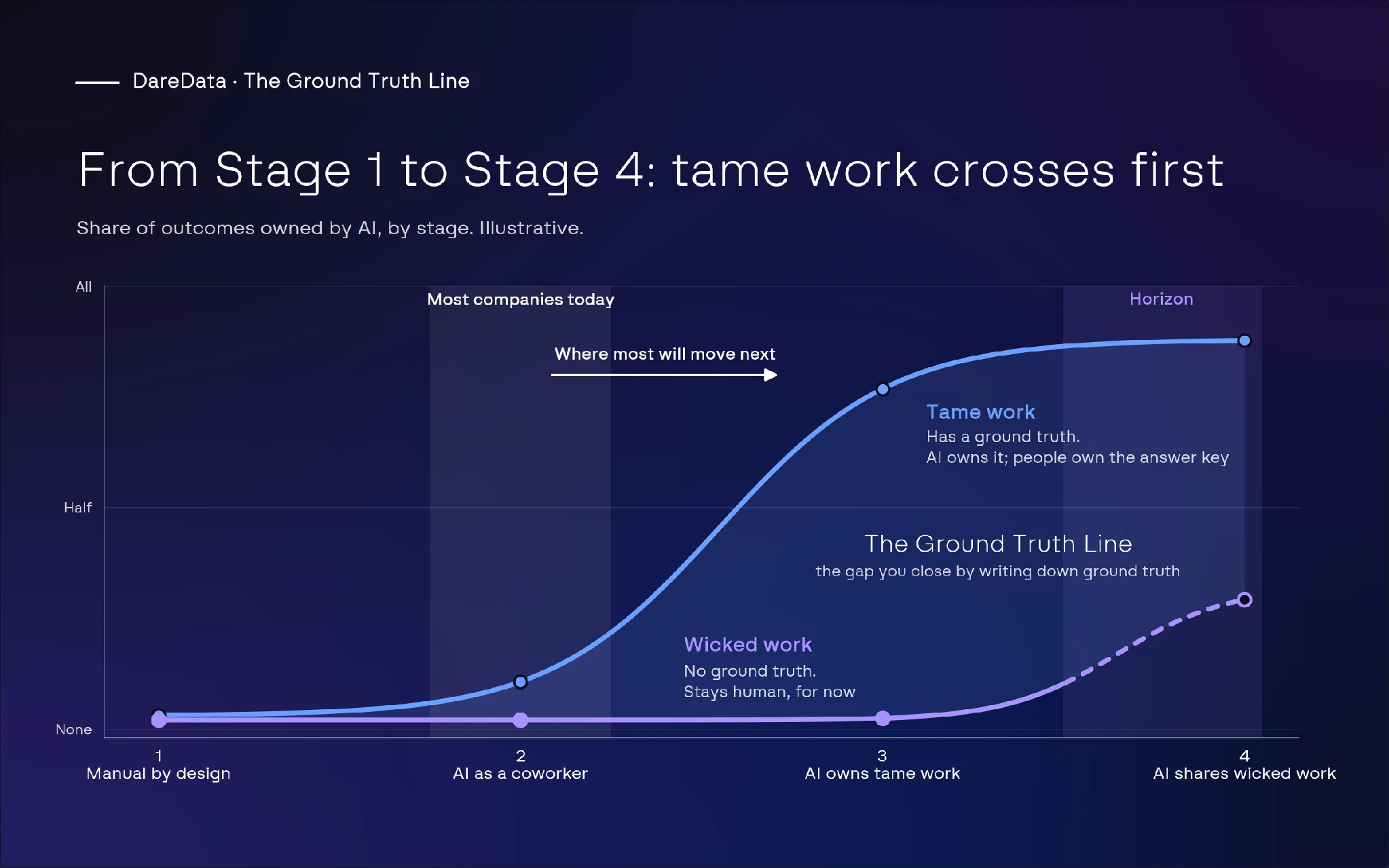
- Work with a right answer to check against (tame work) moves to AI first. Work without one (wicked work) moves last, and for now it stays human.
- Most companies are stuck at stage 2: AI drafts, people check everything.
- Stage 3 starts when you write the right answer down. You can do this now, without better models.
Every company now has access to the same AI models. Yet at NOS, 65% of 20,000 monthly supplier invoices close without a person touching them. At most companies, an analyst still re-checks every AI draft.
The model is not the difference. The difference is whether the company has written down what a right answer looks like.
We call that the ground truth: a right answer you can check an output against, without running an experiment and waiting to see what happens. It reduces every piece of work to one question:
Is there a ground truth to check it against?
If there is, the work can move to AI now. If there is not, it stays with people, however good the models get. That question draws a line through every company: the Ground Truth Line. The companies that move it on purpose are pulling away from the ones waiting for better models.
This piece shows where the line runs, the four stages companies pass through as they cross it, and how to move it yourself.
01 The line
Tame work and wicked work
Work is tame when it has a ground truth. Processing an invoice is tame: you already know what a correct result must contain. The amounts match the purchase order, the supplier exists, the VAT is right. A reconciliation balances or it does not. Code passes its tests or fails them. Check the output against the answer key and you know.
Work is wicked when it has no ground truth, and never will. My favourite example is entering a new market.
Say you decide to expand into Spain instead of Germany. Two years later, Spain is doing fine. Was that the right call? You will never know. You cannot run the other timeline, the one where you went to Germany with the same team, the same money and the same two years. There is no counterfactual to compare against, so there is no way to prove the decision wrong. Spain “doing fine” proves nothing: Germany might have done three times better, or gone bankrupt.
That is the heart of it. Tame work has an answer key. Wicked work only has an outcome, and an outcome without a counterfactual is just a story.
Tame work
Has a ground truth
Wicked work
No ground truth, only an outcome
Invoice matching and reconciliation
Answer key: the purchase order and the rules
Which market to enter next
No answer key: you cannot run the other timeline
Classifying a support ticket
Answer key: the agreed category for that issue
How to position the brand
No answer key: you never see the positioning you did not pick
Extracting fields from a contract
Answer key: what the contract actually says
Whether to reorganise a department
No answer key: you never see the org you did not build
Writing code against a spec
Answer key: the spec and its tests
What product to build next year
No answer key: you never see the product you did not build
Forecasting next week's demand
Answer key: what actually sells next week
Who to promote to lead a team
No answer key: you never see the leader you did not pick
A note on the words
Both terms are borrowed, on purpose.
Ground truth comes from machine learning, where it means the correct answer you evaluate a model against. Anyone who has tested a model knows the rule: no ground truth, no way to say whether the model is any good. The same rule applies to an AI that runs a process.
Tame and wicked come from Horst Rittel and Melvin Webber, who described wicked problems in 1973. Their description fits the market decision almost line for line. A wicked problem has no stopping rule. Its solutions are good or bad, not true or false. There is no ultimate test of a solution, and every attempt is a one-shot operation you cannot undo or rerun. A tame problem is the opposite: a clear goal, a clear check, a clear end.
AI researchers make the same point from another angle. Jason Wei’s Verifier’s Law says the ease of training AI on a task is proportional to how verifiable it is, and Andrej Karpathy adds that a task must be resettable, efficient and rewardable for AI to practise it. Wicked work fails “resettable” by definition. Strategy, positioning, org design, hiring: you only get to play them once.
02 The four stages
Where the ground truth lives, stage by stage
Companies run at four stages right now. Each stage answers two questions differently: where does the ground truth live, and who owns the outcome on each side of the line?
Stage by stage
The stages are not defined by how much AI you use. They are defined by where the ground truth lives and who answers for the outcome. Who types the first draft does not matter much. Who answers for it when it is wrong does.
1 Manual by design
Ground truth lives in people's heads
No AI in the operating model. In 2026 that almost never means no AI at all: somebody in finance is pasting spreadsheets into a chatbot on their phone. But the organisation has not decided anything. AI is a private habit, not a capability. Even the tame work runs on a tacit answer key: the senior clerk just knows when an invoice looks wrong.
The test for stage 1: if every AI tool disappeared tomorrow, would any process break? If the answer is no, you are here.
2 AI as a coworker
Ground truth lives in the reviewer's eyes
AI is sanctioned and everywhere: drafting, summarising, analysing, coding. But humans own every outcome, tame or wicked. The analyst uses AI to build the reconciliation, then checks and signs it. The strategist uses AI to explore markets, then decides. In practice the reviewer is the ground truth: the only way to know an output is right is for a person to look at it.
This is where most companies I talk to are today, and it is a perfectly good place to start. It is also a trap if you stay too long, because human review caps the productivity gain. Every output still passes through a person, because nobody has written down what right looks like. Companies that stay at stage 2 will find it hard to compete.
3 AI owns tame work
Ground truth is written down, and machines check against it
This is the start of the big shift. Once a tame process has its ground truth written down (the rules, the reference data, the labelled examples), AI can own the outcome end to end and people own the answer key. Invoices get matched against purchase orders, tickets get routed, contracts get extracted, and nobody re-reads them. People watch error rates, investigate exceptions and keep the answer key up to date.
Wicked work stays with humans. Not because AI cannot produce an opinion on Spain or Germany (it will happily give you one) but because there is no answer key to check that opinion against, so nobody can safely hand it the decision.
"The job description changes here. In stage 2 your best people do the work. In stage 3 your best people write down the ground truth that lets AI do the work."
4 AI shares wicked work
There is no ground truth, so governance has to stand in for it
AI takes part in, and sometimes owns, decisions with no right answer: which market, which product, which reorg.
I want to be honest here: I have not seen a company prove it can operate this way, and I am not sure today’s AI is the limiting factor. AI already produces plenty of wicked work (copy, design options, strategy memos) and some of it is very good. What companies have not done is delegate authority over those calls, partly because there is no accountability model for it yet. We have glimpses: an agent that proposes and runs its own marketing experiments, AI drafting the strategic options a leadership team then picks from. But stage 4 is a question of trust and governance much more than capability. Who signs off when there is no answer key? Who gets fired when it goes badly?
Until a company can answer that, stage 4 stays a horizon, not a destination. At DareData, we believe the emerging capabilities of AI agents will bring companies to stage 4.
03 Moving the line
The line is not fixed. You can move it.
This is the part we care about. It is tempting to think the models set the line: when AI gets smarter, more work crosses over, and you wait. That is only half true. Companies move their own line and make themselves more competitive. And the ones moving fastest are not waiting for better models. They are turning wicked work into tame work, one piece at a time.
Go back to Spain or Germany. The final call is wicked, and always will be. But the decision is not one block of work. Break it down and most of it is tame.
One "strategic" decision
Spain or Germany?
↓ breaks into
Tame · has a ground truth
Market sizing
Checked against trade, census and industry data.
Tame · has a ground truth
Competitor landscape
Every claim traces back to a source you can open.
Tame · has a ground truth
Cost-to-enter model
Reconciles to real quotes, salaries and tax rules.
Wicked · no ground truth
The final call
You only get to play it once. This part stays human.
01 Decompose
Split wicked decisions into parts, and find the tame parts inside. A lot of “strategic” work is research and analysis wearing a strategy hat.
02 Write down the ground truth
If the right answer only lives in people’s heads, AI cannot be checked against it. Write it down: labelled examples, acceptance criteria, evaluation sets, rubrics. A support reply is “good” only until you define good as resolved on first contact, matching policy, rated well by the customer. Then it has a ground truth.
03 Shorten the loop
Some ground truth arrives too late to help: a forecast you can only check in six months. Robin Hogarth calls this the difference between kind and wicked learning environments. Kind ones give fast, accurate feedback. Wicked ones give slow or misleading feedback. Your job is to make the environment kind.
Helping companies map their tame work and move to stage 3 quickly is what we do at DareData.
04 Caveats
Caveats to the four-stage model
“Companies are not in one stage.”
Correct, and this is the most important caveat. The finance back office can be in stage 3 while the strategy team is firmly in stage 1. Microsoft makes the same point about its own Frontier Firm phases: progress is not linear and most companies sit in several phases at once. So do not label the company. Label each process. A company does not have a stage, it has a profile.
“Having a ground truth is not enough.”
Also correct. A quarterly sales forecast has a ground truth, but it arrives six months later, after the money is spent. For AI to own a piece of work, checking against the ground truth has to be fast and cheap, not just possible. A ground truth that arrives too late to matter is, in practice, no ground truth, and the work counts as wicked.
“Some tame work is too dangerous to hand over.”
A ground truth tells you whether AI can own the work. Stakes and reversibility tell you whether it should, and how much human oversight stays in the loop. That is why the map below has two axes, not one. It is also why the NOS legal workflow routes every uncertain case to a person with full context instead of guessing. And it is why human-in-the-loop is a core part of our GenOS platform.
“The line is fixed, so the stages are just a function of model quality.”
This is the objection we disagree with most, and it is the whole point of the previous section. Companies that write down their ground truth move their own line. And even if AI stopped improving tomorrow, there is already enough to embed in companies to keep us busy for decades.
05 How to use it
Map processes, not the company
The useful output of this framework is not “you are a stage 2 company”. It is a map of every process you run, placed on two axes: how solid its ground truth is, and how much a wrong answer costs.
High cost of a wrong answer
Humans stay in charge, for now
Wicked work. Ask: can it be decomposed, or given a ground truth?
- Which market to enter
- Who to promote
- Department reorg
- Quarterly sales forecast (ground truth arrives too late)
AI plus a human sign-off
The ground truth exists, the stakes keep a person in the loop
- Regulatory filing
- Payment run
- Legal request handling
Low cost of a wrong answer
Decompose it, or write down its ground truth
Lower stakes, but no ground truth yet
- Brand positioning
Stage 3 starts here
Written ground truth, fast to check, a wrong answer you can live with
- Invoice-to-PO matching
- Contract field extraction
- Support ticket routing
- Next week's demand forecast
No ground truth yet
Written ground truth, fast to check
The exercise is simple enough to run in a workshop:
- List the processes, not the departments. "Accounts payable" is too big. "Matching supplier invoices to purchase orders" is the right size.
- Ask the ground truth question for each one: is there a right answer to check against, and how fast and cheap is the check?
- Score the stakes: what does one wrong answer cost, and can you undo it?
- Read your profile. Bottom-right processes are your stage 3 candidates today. Top-right ones get AI plus a human sign-off. For everything on the left, ask whether it can be decomposed or given a ground truth, and move it.
From our work Across the line, in production
Tame work we have already handed to AI
06 The line is the strategy
The line is the strategy
The AI question is not a technology question. The companies pulling ahead are not the ones with the best models: everyone has access to the same models now. They are the ones that know exactly where their Ground Truth Line runs, and push it on purpose. These companies will be the most competitive, and they will run at stages 3 and 4.
Sources
- Jason Wei, Asymmetry of verification and verifier’s law
- Andrej Karpathy, Verifiability
- Microsoft WorkLab, The CEO’s guide to building a Frontier Firm
- Horst Rittel and Melvin Webber, Dilemmas in a General Theory of Planning, Policy Sciences, 1973
- Robin Hogarth, Educating Intuition, 2001
- DareData success stories: NOS, Sonae Sierra, BERD, COFICAB, Greenvolt, WOO, Central de Cervejas, at daredata.ai/success-stories