.jpeg)
The Opportunity
Fragmented data across teams and sites
Different teams and laboratory locations had evolved their own tools, formats, and naming conventions over time. The same type of experiment could be documented in three different ways, in three different places. This fragmentation led to duplicated datasets, inconsistent records, and limited cross-team visibility.
Manual processes slowing research
Scientists naturally prioritized experimentation over documentation. Critical steps often relied on manual forms, spreadsheets, or email threads. That made data entry slow, error-prone, and often incomplete.
Limited collaboration and inisights
Without a unified data layer, connecting experiments, datasets, and teams required a lot of institutional memory and informal coordination. This restricted analytics, slowed decision-making, and made it harder to reuse past work.
The Solution
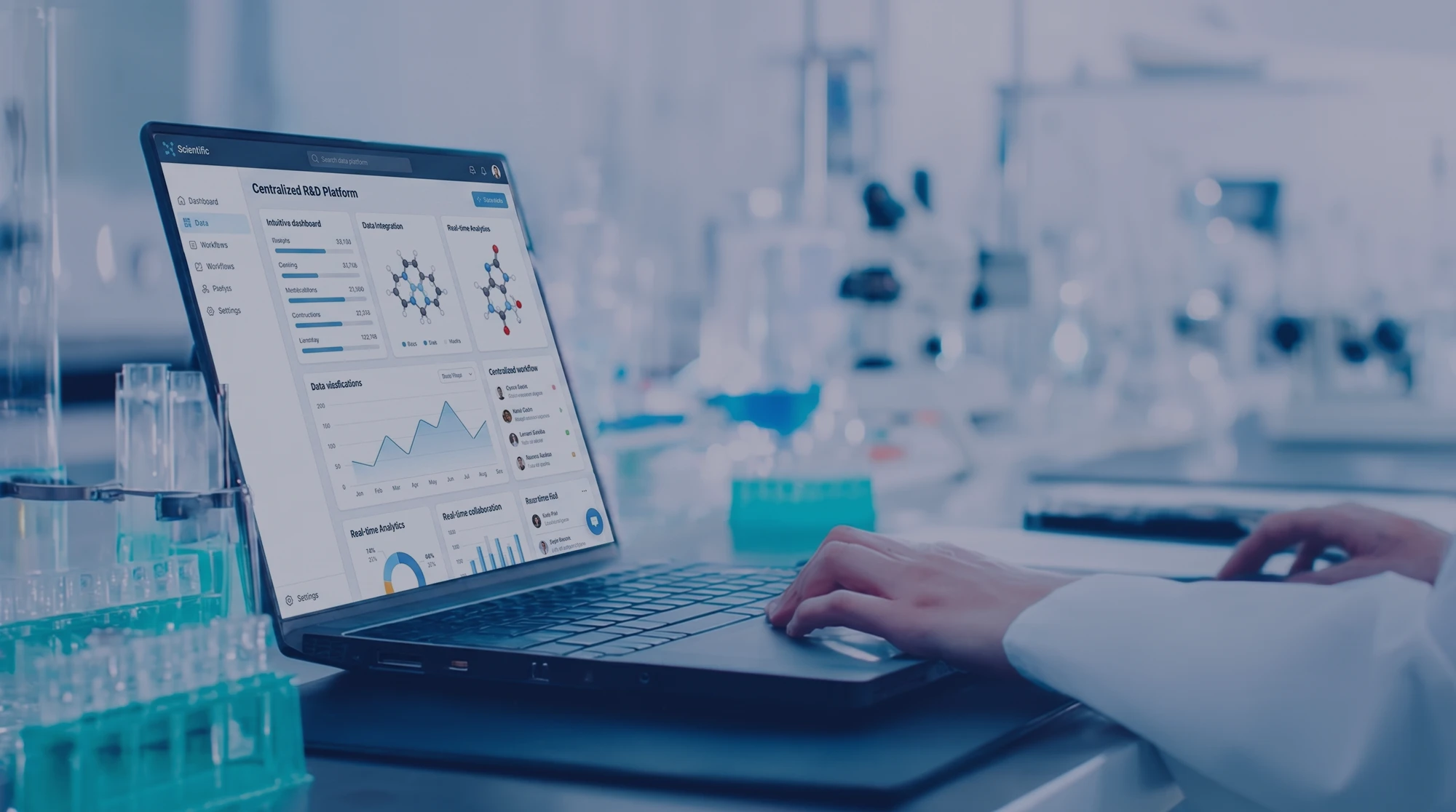
We built a centralized R&D intelligence platform designed to integrate and structure data across multiple teams and research environments.
At its core, the platform unifies data from diverse sources into a single system, automatically ingesting and transforming information into a consistent, structured format.
An ontology-driven data model connects experiments, teams, datasets, and resources, enabling queries and insights that were previously not possible. Researchers and decision-makers can navigate complex relationships across the organization in a simple and intuitive way.
The platform integrates directly with existing laboratory and operational tools through APIs, ensuring continuous data flow without forcing scientists to change how they work overnight.
Built with scalability in mind, the system processes large and complex datasets in near real time, supported by optimized data pipelines and efficient transformation logic. The architecture is designed for reliability, performance, and adaptability as data volume, complexity, and usage grow, from a handful of early adopters to organization-wide adoption.
The Impact
The platform changed how scientific teams access, share, and use data across the organization.
Manual processes that once depended on email chains and ad-hoc spreadsheets are now handled by automated workflows, reducing turnaround time and freeing scientists to focus on experimentation. Requests that previously required chasing people for context can now be answered by querying the platform. Data that was previously siloed by team, site, or tool is now centralized and discoverable. Researchers can see related experiments, reuse existing datasets, and avoid duplicating work that has already been done elsewhere in the organization.
Most importantly, the organization now operates on a scalable data foundation. As research gets more complex, new teams and projects plug into the same backbone, maintaining efficiency, consistency, and control.